
10 Ways to Walk a More Serene Camino and Avoid the Bed Race

There’s no denying that more people than ever before are walking the Camino, and at certain times of year or on some busy stretches, finding a bed can be a challenge. But is the bed race real? Is the Camino de Santiago getting just too crowded, especially the Camino Francés? Should you choose a different route than the Francés or skip the Camino altogether? In this article, I share 10 simple and practical tips to help you avoid the bed race and experience more peaceful moments along the Camino Francés.
But before jumping in, I want to say two quick things:
1. In my opinion, The Camino Francés Is Busy, But Not As Bad As People Say
Yes, more pilgrims than ever are arriving in Santiago, but that doesn’t mean it’s chaos. In the past, most people just walked the Camino Francés. But these days, pilgrims are spread out across lots of routes like the Portugués, the Norte, the Primitivo, the Inglés, and more. And the infrastructure on the Francés has also improved a lot over the past 10 to 15 years. Sure, there are busy stretches, like the first few days from Saint Jean to Pamplona or the final section from Sarria to Santiago, but in my experience, it still doesn’t feel overcrowded. I believe that the Camino Francés is still in that Goldilocks zone, not too busy and not too quiet. I’ve have stayed in plenty of half-empty albergues, often walked for hours without seeing anyone, and when I walked this May, I even had an albergue entirely to myself.
2. I wouldn’t dismiss the Camino Francés, especially if it’s your first time.
I know every Camino route is unique, and I love them all. But there’s just something special and magical about the Camino Francés. I think it’s the perfect path to take your first steps on the Camino. There’s a reason so many Camino books and films, from the 12th-century Codex Calixtinus to Martin Sheen’s The Way, follow this route.
Maybe it’s the ever-changing landscapes, starting in the mountains, then through the green hills of Navarra, into the wine country of Rioja, across the wide open Meseta, back into the mountains, and finally down into the misty, forested magic of Galicia.
Maybe it’s the mix of cultures, from French Basque villages to bull running in Navarra to the Celtic vibes of Galicia.
Maybe it’s the quiet villages, or the historic cities like Pamplona, Burgos, and León, where there’s something around every corner: old churches, crumbling ruins, grand cathedrals, and ancient castles.
And then there are the amazing albergues, and over a thousand years of hospitality from the locals. But more than anything, it’s the fellow pilgrims you’ll meet, people of all ages and fitness levels, each walking for their own reasons. The Camino Francés is by far the most social of all the routes, so if you’re hoping to connect with others along the way, this is the one.
To me, the Francés will always be the heart of the Camino, the most iconic and rewarding of them all. And don’t worry, once you walk it, you will catch the bug and be back to explore all the other Camino routes.
So with that out of the way, let’s get into 10 practical tips to avoid the bed race and enjoy a quieter Camino… 😊

Tip 1 – Consider the time of year when you walk
Let’s start with the obvious one, the time of year you choose to walk. The Camino Francés is busiest in May and again in September. No surprise there. May brings ideal walking weather, and the Meseta is lush and green, while September also offers perfect walking weather with the bonus of harvest time, when the grapes are full and plump. But if you’re after a quieter experience, unfortunately, you’ll want to avoid those two months.
April and June, and July and August, are usually a bit less hectic, though July and August can get very hot. The rest of the year, especially winter, is much quieter. So if peace and space matter more to you than perfect weather, then walking outside the busiest months might be the way to go.


Tip 2 – To Book or Not to Book?
Let’s talk about booking ahead. I’ll be honest, I’m not a big fan of planning too far in advance. For me, one of the best things about the Camino is the freedom to take each day as it comes. Most of us live life on a tight schedule, so being able to walk without pressure or deadlines is a real gift.
That said, there are definitely times when booking makes sense.
The first few days from Saint Jean to Pamplona can be pretty busy and feel a bit like a bottleneck. You might have just arrived in Spain and not quite settled into the Camino rhythm yet, so it’s nice to have your bed sorted for those first few nights. I definitely recommend booking ahead for that stretch. There are loads of albergues to choose from, and you will find them in your guidebooks or apps. You can book a day or a few days in advance, but keep in mind that some of the popular ones, like Beilari in Saint Jean, Orisson, and Suseia in Zubiri, often fill up weeks or even months in advance, so grab those early if you can.
The same goes for your final night in Santiago, especially during the busier months. Accommodation in the city can fill quickly, so it’s worth reserving that one in advance too.
For the rest of the Camino, booking a day or two ahead is usually enough. You can book most private albergues online through their own websites, on booking sites like Booking.com, or by calling, emailing, or messaging them on WhatsApp.
Two quick things to keep in mind:
If you’ve made a booking but can’t make it, just let the albergue know. Most of these are small, family-run places doing their best to keep things going, and no-shows can really affect them. A quick message is all it takes, and it means they can offer the bed to another pilgrim, too.
If an albergue shows as full on Booking.com, it’s still worth checking in person. Some places keep a few beds for walk-ins or get last-minute cancellations, so you might still be in luck.


Tip 3 – Don’t Arrive Too Late
In addition to the private albergues, there are municipal and donativo albergues that do not take reservations and operate on a first-come, first-served basis. But instead of saying “arrive early,” I prefer to say just “don’t arrive too late.” As the Camino is not a race, there is no need to rush.
In all my years walking the Camino Francés, I have never been left without a bed at a municipal or donativo albergue. The hospitaleros usually find a way to help. That said, to play it safe, try to arrive by early afternoon, especially if you are aiming for a popular or smaller donativo albergue.
If you show up after 6 pm, there’s a higher chance it might be full. But even then, there’s usually a solution, even if it’s just a mat on the floor. The Camino has a way of looking after you.


Tip 4 – Stay Between the Stages
Most guidebooks suggest popular stage towns for starting and finishing each day’s walk. And while they do not say you have to stay in those towns, most people do, so they tend to get busy, and beds can fill quickly.
My advice is to walk a bit longer or stop a bit earlier on one of the days to break the pattern. By staying in one of the smaller villages between the typical stage towns, you will often find quieter, more peaceful albergues and a more relaxed Camino experience.
The best part is you will not be walking with the big wave of pilgrims each morning. Instead, you will be ahead of the pack or behind it, and you will often have long stretches of the trail all to yourself.


Tip 5 – Take the Scenic Alternatives
There are numerous scenic alternative routes along the Camino Francés that veer just slightly off the main path, usually adding only a couple of extra kilometres to your day. They are almost always quieter, often more beautiful, and they pull you away from the roadside and into a more peaceful rhythm.
Take them. Every time.
Not only do they offer a more relaxed walking experience, but they also pass through small villages that many pilgrims skip, and often these villages have lovely albergues with plenty of space.
Here are a couple of examples. Just after Estella, there’s a forest path that leads into the village of Luquin. I stayed at the albergue there this May, which is the busiest time of year, and there were only three of us staying. I didn’t pass a single pilgrim on the way in.
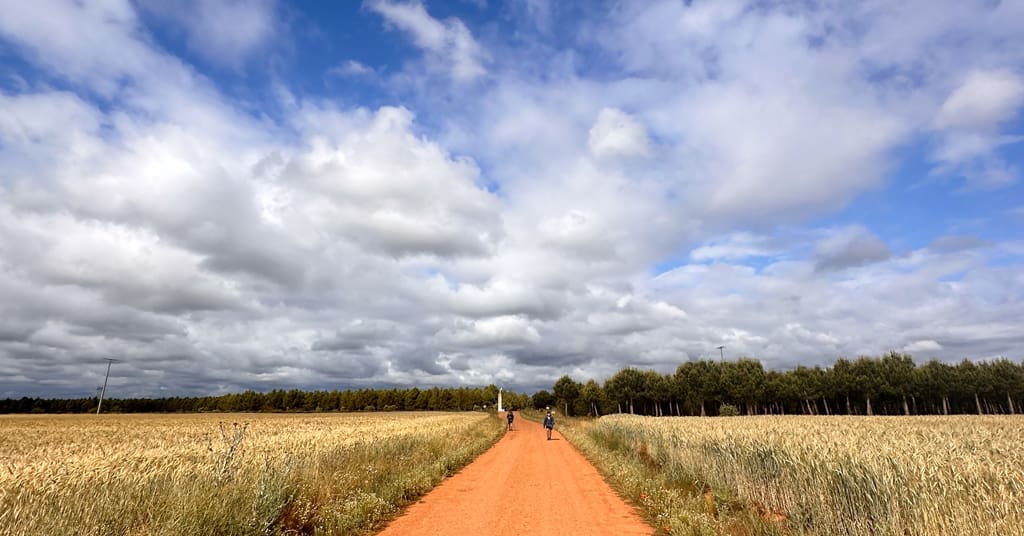
Or take the stretch along the Roman Road after Sahagún. This alternative route is called the Vía Traiana, the older Roman path that passes through Calzada del Coto and Calzadilla de los Hermanillos. It’s one of the quietest and most remote sections of the Camino, with peaceful little villages and no crowds at all. Definitely no bed race here.


Tip 6 – Think About When You Start
I already mentioned the time of year you start walking the Camino, but it is worth zooming in a bit more. Think about the month, the day, and even the time of day you choose to begin.
Here is something I have noticed. Maybe it is just anecdotal, but a lot of pilgrims seem to take a full calendar month off to walk. That means the start of each month tends to be busier at main starting points like Saint Jean or León. This creates a wave of pilgrims moving together across the route. To avoid that, consider starting in the middle or at the end of the month. You may find things a little calmer.
The same goes for the day of the week. Many people finish work on a Friday and are eager to get started, so Saturdays, Sundays, and Mondays can be more crowded at the starting points. If you want a quieter beginning, start midweek. Tuesday or Wednesday is usually a good bet.
Also keep an eye on Spanish holidays like Labour Day on the first of May or the Assumption of Mary on the fifteenth of August. These dates bring a noticeable increase in local pilgrims, often walking just a few days, which can make the trail and the albergues busier than usual.
And finally, think about the time of day. Most pilgrims are up and walking by six or seven in the morning, creating a steady flow along the path. If you enjoy a more peaceful, reflective walk, try heading out later in the morning or taking a long break and walking in the afternoon. There is something really special about walking with the light low and golden, the trail quiet, and just a few butterflies for company.


Tip 7 – Stay Just Outside the Bigger Towns and Cities
Earlier, I mentioned staying between the guidebook stages, but another great way to find a bit more peace and avoid the crowds is to stay just before or just after the big cities.
Most pilgrims naturally aim for the larger towns and cities, like Pamplona, Burgos, or León, but if you are looking for a quieter Camino experience, consider stopping just before or pushing on a little past the main cities.
For example, just before Pamplona, there’s the Albergue Parroquial de Zabaldika, a beautiful and peaceful little spot run by nuns, and just after Pamplona, in the village of Cizur Menor, about 5 km on, you’ll find the Order of Malta albergue. Similarly, just after Burgos in Rabé de las Calzadas, I really loved Albergue Liberanos Domine. It’s a proper family-run place with a real homely feel. And just after León, in Oncina de la Valdoncin, there’s Albergue El Pajar de Oncina, a lovely little oasis with hammocks and all.
The same goes for all the towns along the Camino. Just outside them, in the suburbs or on the edges, you will often find some of the most memorable albergues. These places can get overlooked, but they have loads of charm. They are usually quieter and often become your favourite stops. You still get to enjoy the buzz of the city during the day, then head back for a peaceful night’s sleep just a little down the road.


Tip 8 – Consider a Quieter Route into Santiago
There is no getting around it, the final stretch from Sarria to Santiago is the busiest section of the Camino. Thousands of pilgrims start their journey in Sarria every year, walking just the final one hundred or so kilometres to earn their Compostela.
Now, I do not want to knock this stretch. It has great energy and a real buzz, especially if it is your first Camino. But if you are looking for a quieter, more reflective journey into Santiago, it is worth considering an alternative route for those final days.
One popular option is to veer off the Francés in Ponferrada and connect with the Camino Invierno (The Winter Way), a stunning and much less travelled route that leads all the way to Santiago.
That said, I really love the stretch just after Ponferrada to O Cebreiro. It is one of my favourite parts of the whole Camino. After Ponferrada, you pass through the Bierzo vineyards, arrive in Villafranca del Bierzo, a real gem of a town, and then tackle the legendary climb to O Cebreir, and if you are up for a bit of adventure, you can even take the Dragonte Route, a challenging but absolutely breathtaking detour through the mountains.
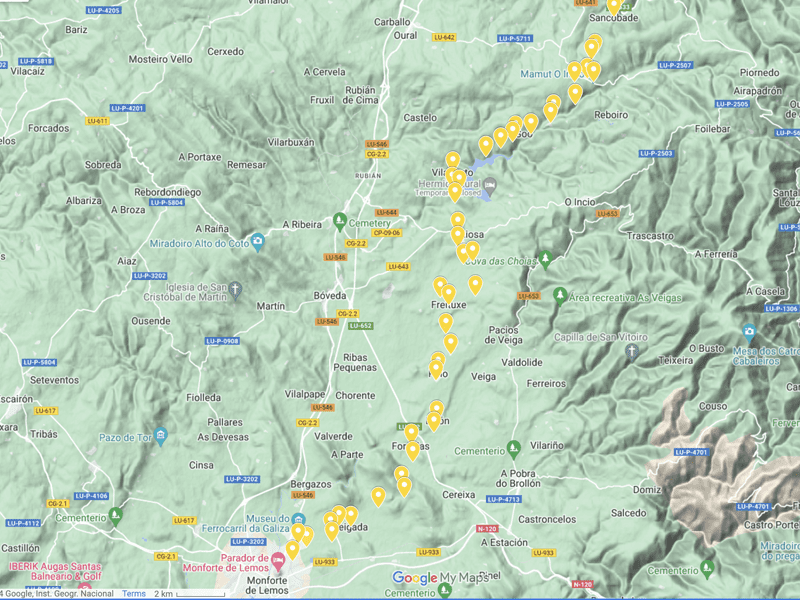
So last year, instead of turning off at Ponferrada, I kept going to the monastery at Samos, which is well worth a visit and from there, I branched off and joined the Camino Invierno. I followed it for the final five days into Santiago, and it was pure magic. Quiet trails, peaceful albergues, and barely another person in sight. It was incredible.
👉 Here’s the route I took from Samos to connect the Camino Frances with the Camino Invierno

Tip 9 – Start in Somport Instead of Saint-Jean?
Apart from the final 100 kilometres from Sarria, the other consistently busy stretch on the Camino Francés is the beginning, from Saint-Jean-Pied-de-Port to Pamplona. It is incredibly beautiful and a great challenge to start with, but it can feel a bit crowded, especially during peak season.
If you are looking for a quieter and less travelled alternative, consider starting your Camino in Somport, high in the Pyrenees, and walking the Camino Aragonés. This route takes you through stunning mountain scenery and peaceful villages before joining the Camino Francés at Puente la Reina.


Tip 10 – Carry a Tent for Total Freedom
Finally, the ultimate way to completely avoid the bed race is to bring a tent.
Now, officially, wild camping is not allowed on the Camino. The main concerns are usually around forest fire risks and protecting the landscape. That said, if you are respectful and keep a low profile, you will often find somewhere to pitch your tent without any trouble.
Many albergues, even in towns, have small gardens or grassy spots out the back, and in my experience, most owners are happy to let you pitch your tent, maybe for a small fee or maybe for free. There are also some designated campsites along the Camino, and I plan to put together a proper list of those soon.
If you like having a bit more flexibility and doing things your own way, bringing a tent gives you the freedom to walk as far or as little as you want each day without stressing about where you’ll sleep. It’s still the Camino, just your version of it, with a roof over your head every night, even if it’s made of canvas.


So those are my top 10 tips for avoiding the bed race and finding quieter places to walk.
Remember, the Camino Francés, apart from a few busy sections at certain times of year, is still mostly quiet. Yes, lots of people walk it, but they’re spread out over nearly 1,000 km, so you’ll always find moments of peace and time to yourself.
And if this is your first Camino, and you want to find a community. I really recommend starting with the Camino Francés. It’s just so special. The history, the cathedrals, the cities, the ever-changing landscape, the tradition, the amazing places to stay and most of all, the people you’ll meet from all over the world.
Buen Camino. 💛
10 Unforgettable Albergues I Loved on the Camino Francés


Super article. Informative and has totally put me at ease about walking my first Camino. After a lot of reading, I was beginning to wonder if my choice of the Francés was the right one. Worried there would be too many people. Thanks for sharing 😊
You’re very welcome, Lynn! Enjoy the planning. Buen Camino 💛
A great article with valuable information! Just beginning planning for our first Camino!
Thanks very much Lynne, glad you enjoyed, best of look with your planning. Let me know if you have any questions at all. Buen Camino. 💛